How does one navigate the 5-dimensional space of TMPS4? One uses highways consisting of surfaces that admit a half-turn symmetry about (say) the z-axis such that the quotient has genus 1. The projection is typically branched over six points, so we can navigate the highway by deforming the torus and the six branched points. This approach has been useful for most of the known TMPS4 surfaces and has also been instrumental in constructing the Two Towers. There are surprises. If we take a sufficiently generic surface in NCSHT (the non-centrosymmetric surfaces in TMPS4 that admit a torus quotient by a half-turn symmetry), we can fix the torus and just attempt to deform the divisor. This leads to divisor curves that can be drawn and studied. For instance, doing this for CS4, the genus 4 triply periodic Costa surface, we get the following picture: six curves of branched points on the same torus:
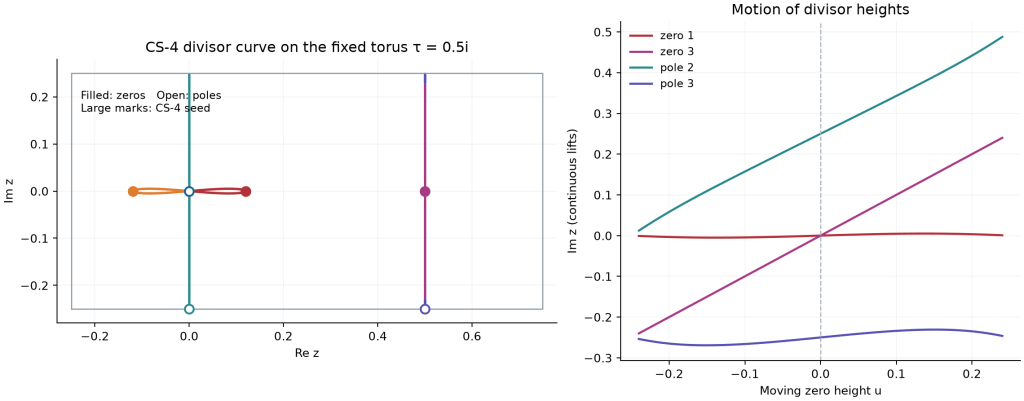
This looks nice and tidy, so we followed the invitation, stayed on this torus, and approached the boundary of TMPS4 by following the divisor curve:
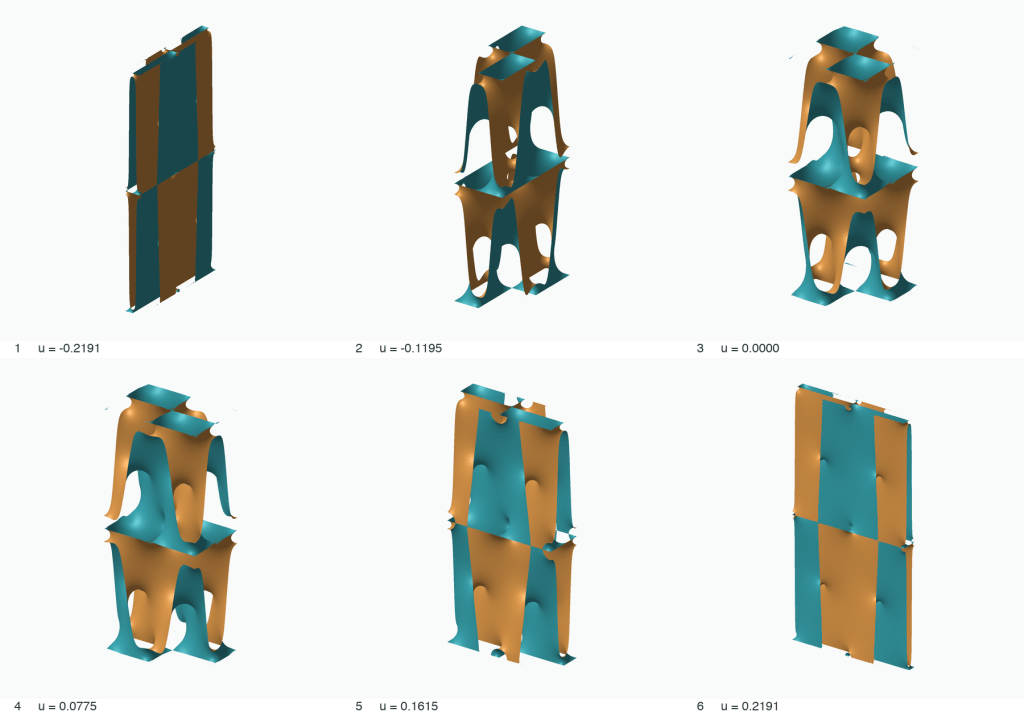
The endpoints looked interesting, so we had a closer look:
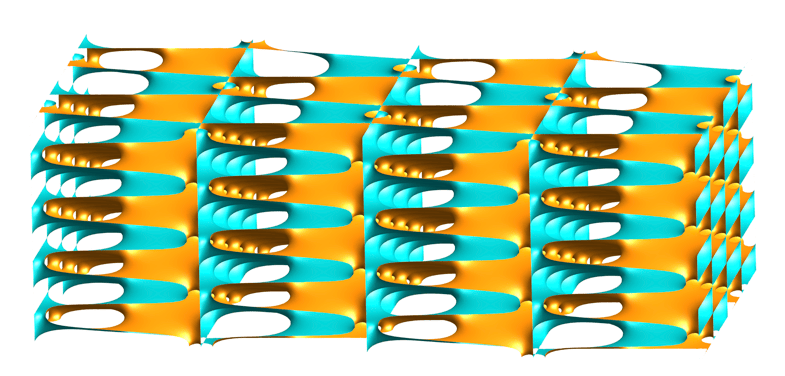
What we see here is, in fact, a gluing of H+2H– with H–, in other words, a singly periodic genus on helicoid of spin +1 with an ordinary helicoid of spin -1. The balance configurations for this gluing lead to surfaces like the one above on every torus. Then there is also a more exotic nodal divisor on and near the hexagonal torus, where the two nodes are shifted by the third of a period:
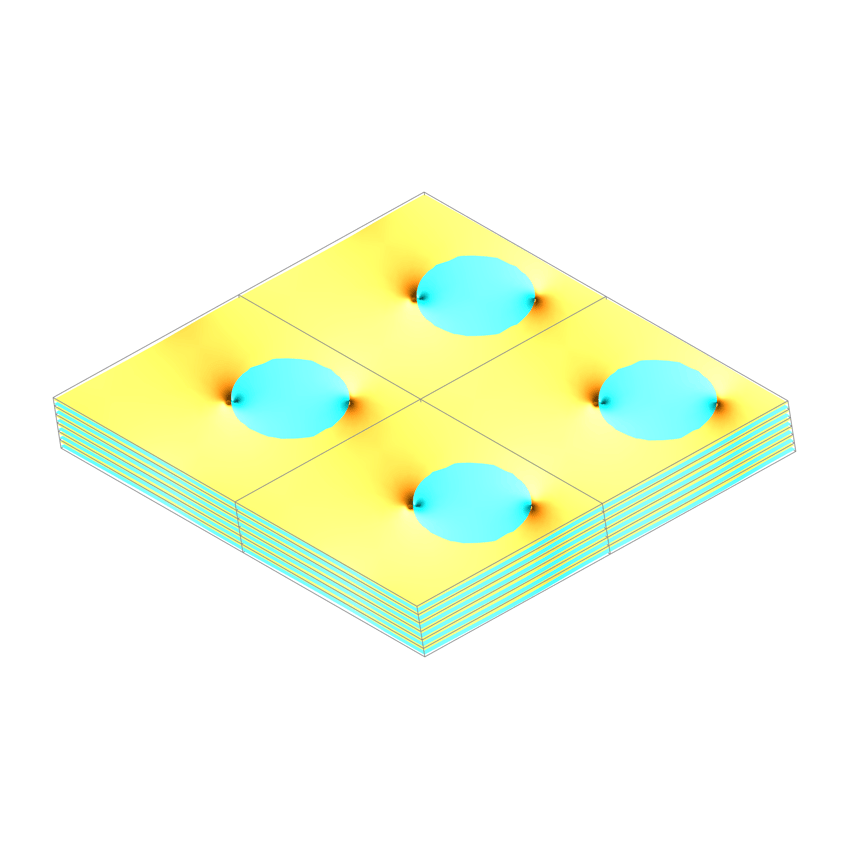
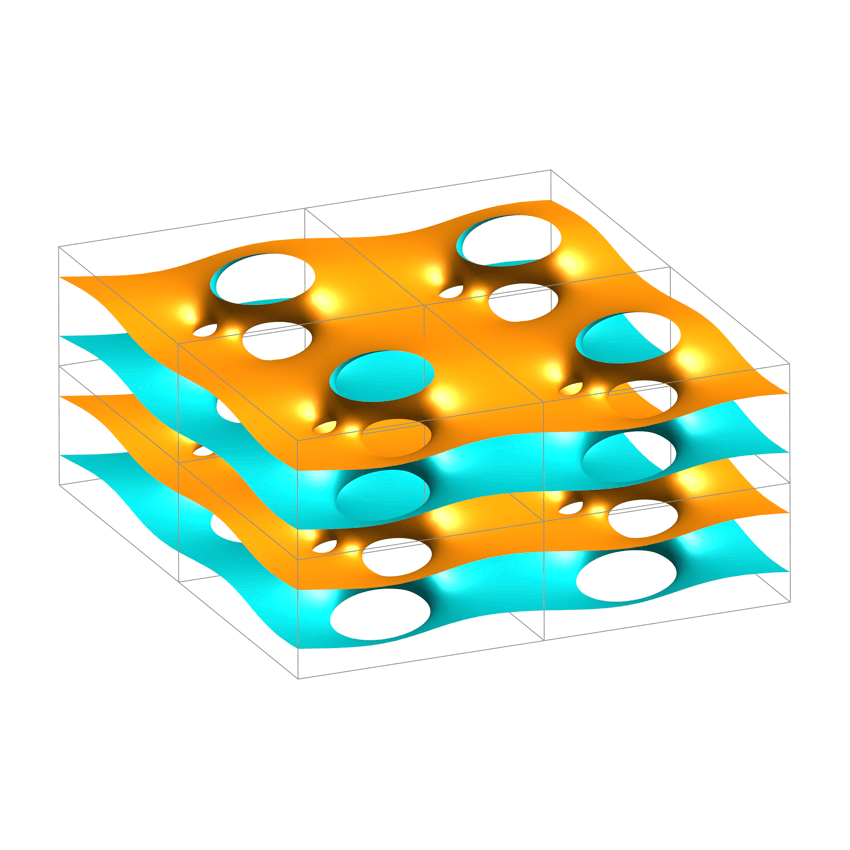
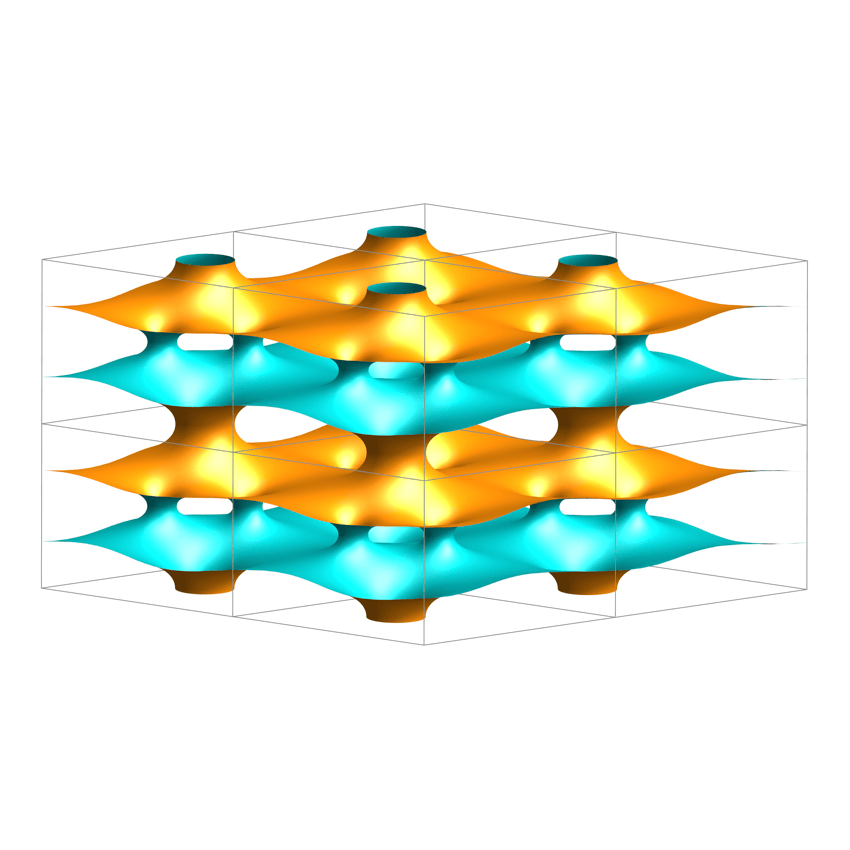
This type of gluing is little understood, and many open questions remain.
Divisor curves can be significantly more puzzling. Here are the divisor curves for three chiral H’-T surfaces.
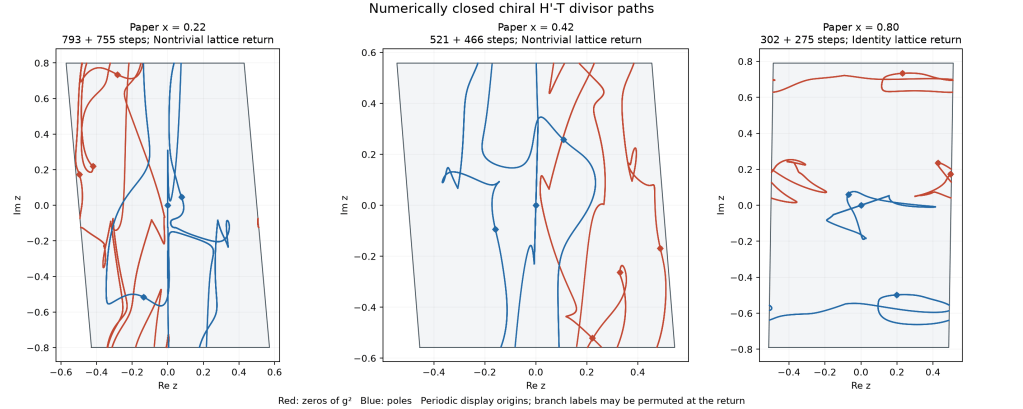
All surfaces on these curves lie in NCSHT. The last one corresponds to the following dance of surfaces, representing once more a non-trivial closed loop in TMPS4:
There are more surprises: Generic surfaces in CSHT can only have rectangular or rhombic half-turn quotient tori, and there are divisor surfaces instead of curves.


