
Daniel Freese investigated in his thesis (page 60) a remarkable balance configuration of 9 helicoids. Five with positive spin are being placed at 0 and at (k=1,2,3,4), and four more with negative spin at , where , , and .
Regeneration produces at about 92º twist a surface where we can still recognize the configuration:
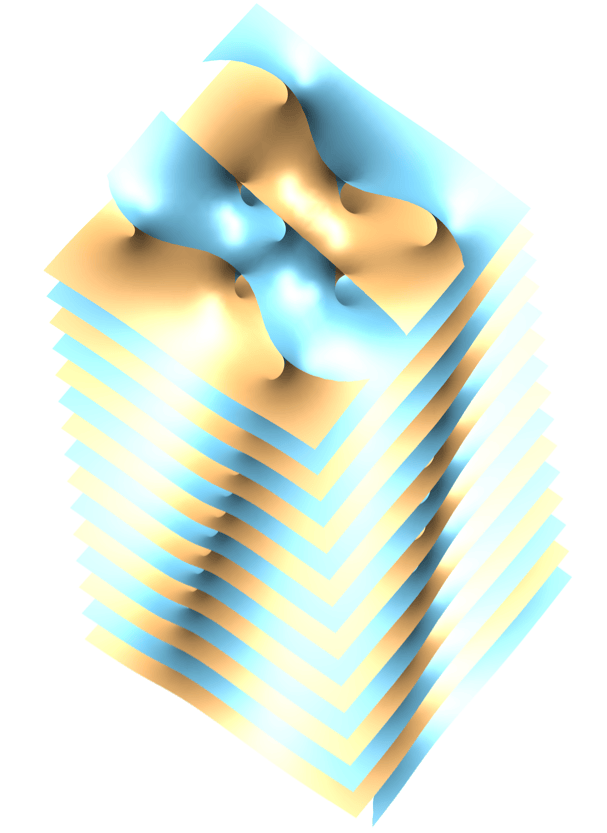
In the quotient, this surface has genus 2 and 2 ends, so there was hope it could be untwisted to an exottic genus 2 helicoid.
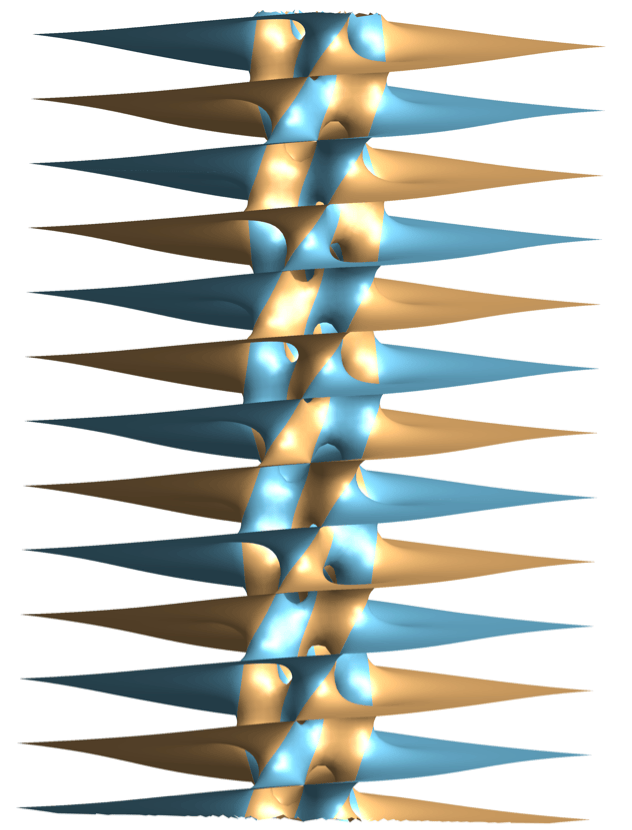
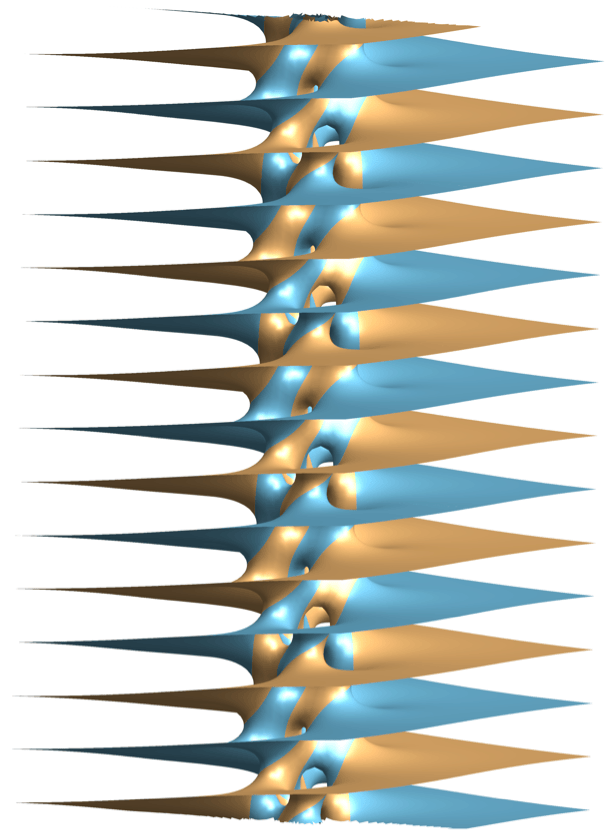
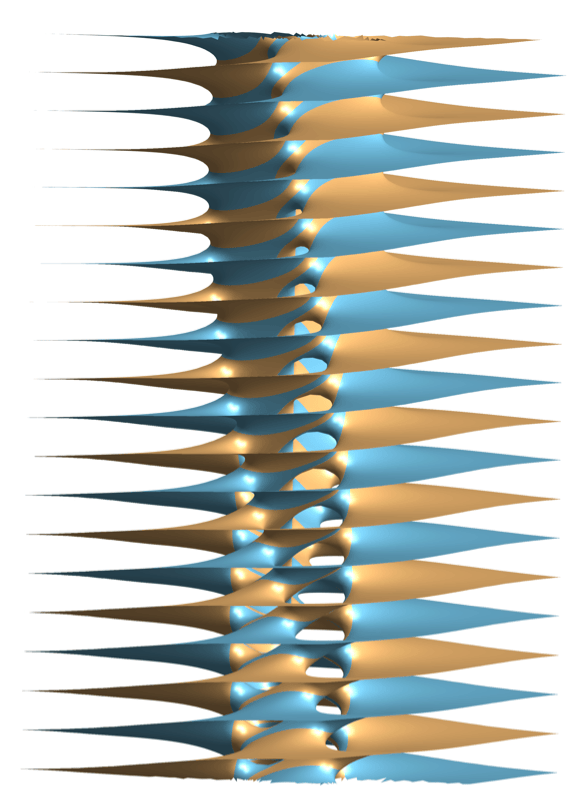
Above is this surface at twist angles 112º, 135º, 172º.
But the surface desides to turn back to another nodal configuration, a cross of 5 helicoids:
Two helicoids with negative spin are at with and helicoids with positive spin at 0 and with .
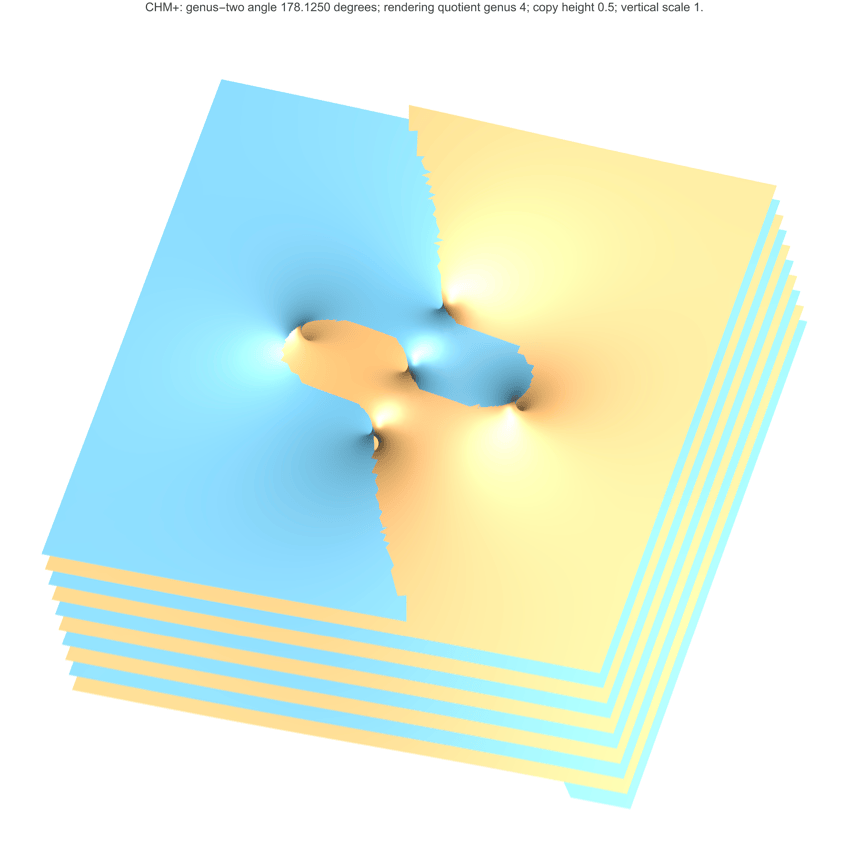
All this is purely numerical. We tryly only know that we have embedded families near the two balance configurations, and all the credit goes to Daniel. The rest is a numerical propagation of the family. We have no general technique for that, and no theorem that predicts what happens to a surface family after successful regeneration.
We also have the related question whether any such balance configuration will lead to an exotic genus g helicoid.
A final important aspect is the esthetical aspect. All these surfaces are stunningly beautiful and mysterious, enough reason to explore.

