An early gluing construction of Martin Traizet allowed gluing families of singly periodic Scherk surfaces together to create triply periodic minimal surfaces. His original construction allowed for Scherk surfaces of different frequencies. But the phases had to be anchored, for instance by requiring a horizontal symmetry plane.
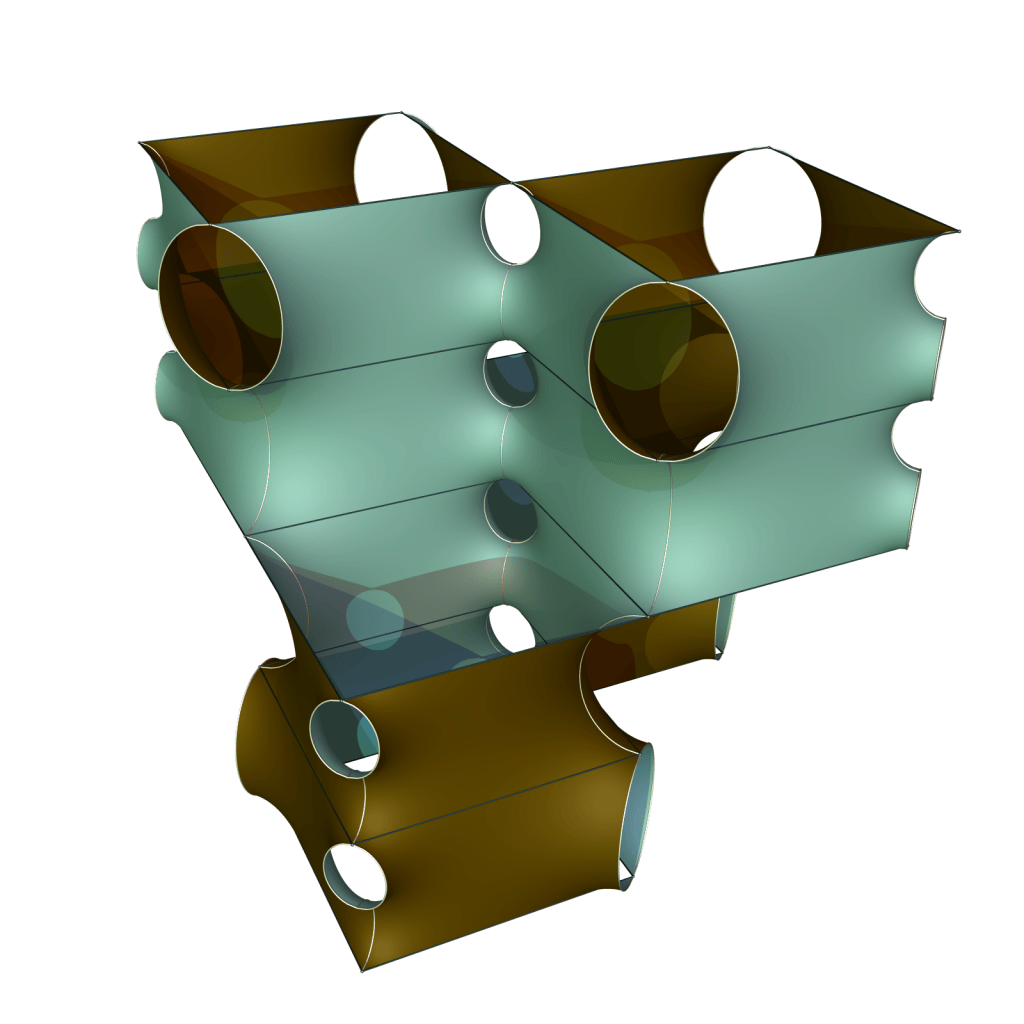
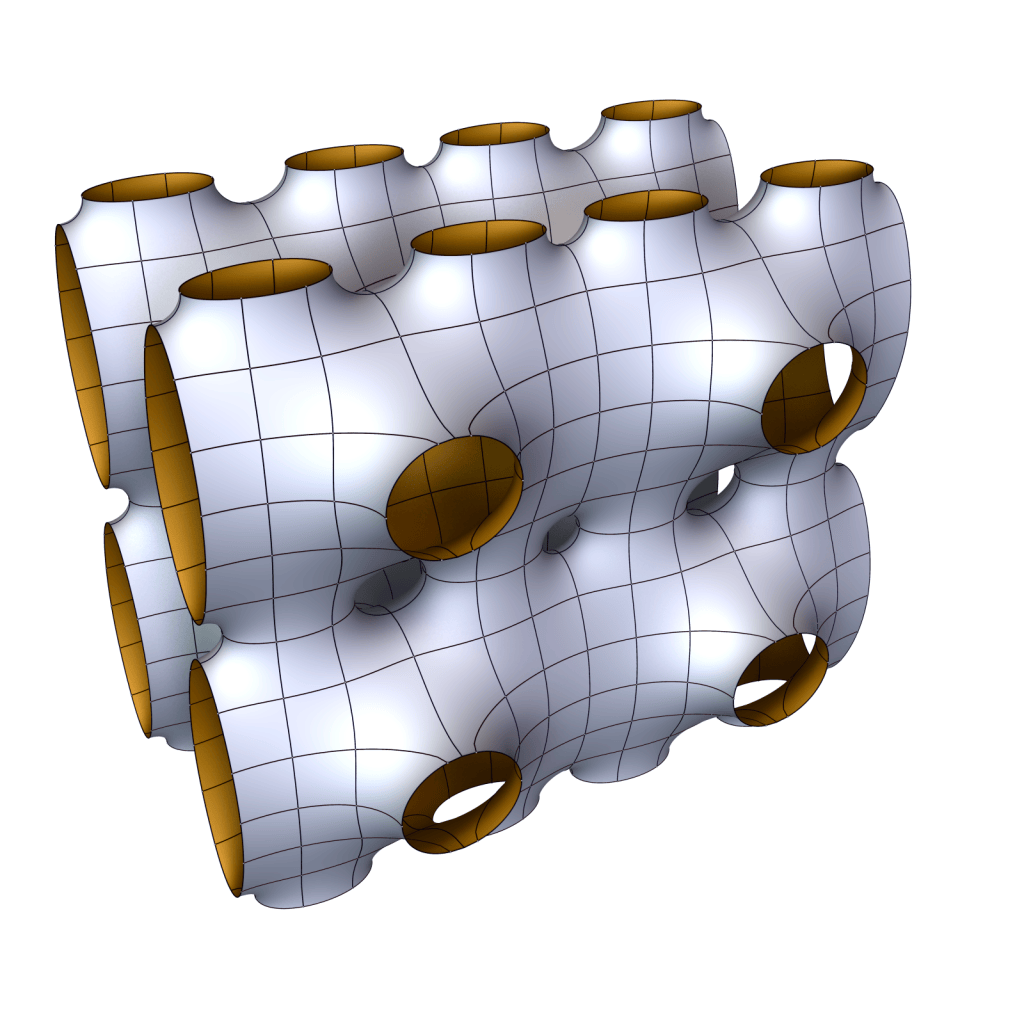
Examples of genus 4 include Wei’s surface (to the right) and a version with straight lines on the left. Both these surfaces pose only a 1-dimensional period problem and have simple existence proofs.
Several years ago, I found a way to numerically and minimally connect the two surfaces, and I made a short movie that suggested that it was possible to slide the two Scherk surfaces independently.
Nobody I showed it to believed that this was possible. I am reviving this because there has been recent progress. We now have an AI-assisted existence proof (based on interval arithmetic) and embeddedness proof. The embeddedness is based on deforming these surfaces to Traizet nodal limits on tori, where the slide deformation is already visible.
There are many open problems:
- The monodromy acts non-trivially on the homology of the quotient surface, but trivially on the homology of the quotient lattice torus. Simply put, the handles really move, but the lattice only wobbles. Can one adjust the parameters so that the lattice stays rigid?
- Are there other examples of non-simply connected moduli spaces of embedded minimal surfaces?
- The space of embedded triply periodic minimal surfaces of genus 4 is now well studied. Is it connected? How many (irreducible) components does it have?
This is a collaboration with Carlos Cardona and Codex 6.1.
Our goal is not to solve famous conjectures, but to open up new territories for more research. We don’t think that AI-supported proofs are the end, but rather a beginning for research that leads to new understanding.
The full (near 40 MB) audit package is here, it contains all that is needed to verify all claims.
The proof does not use an end-to-end gluing of Scherk towers, nor does it claim that the lattice remains fixed during the slide deformation. It is not intended for publication in this form, it is supposed to (hopefully) establish a fact and encourage research. The proof relies heavily on exact interval arithmetic (using Arb), this is not what I would consider ideal, to say the least. Finding reasons why and when such deformations are possible feels like an excellent research topic.
Hao Chen has joined the team; his questions and comments have led to an updated audit package. I thank him for his interest and contributions.


My pleasure. The proof package is up now.
OK, my world saved, phew. And I can totally see a way to wobble the catenoids to allow such a sliding.
No, I don’t claim that the lattice stays rigid.
My belief is always the following: If the two towers have commensurable periods, you can not continuously slide one tower with respect to the other without a perturbation of the lattice. Numerical on my side suggests a tiny but nonvanishing perturbation (wobble) of the lattice. I hope your proof is not against this belief.
OK, I see that you mentioned “the lattice wobbles”. Then it’s totally expected.
Apart from the singly Scherk gluing, we also checked catenoid limits of Scherks, and tried to glue two Scherks near the catenoid limit. Check https://dr-how.github.io/documents/DegenerateTower.pdf , Prop 4 in Sec 2.3. The balance near the catenoid limit also suggests the necessity of symmetry. This makes me more surprised.
You had me convinced, so I am as surprised as you. I came across the two towers while working on another problem (more about that soon). The proof does not rely on end-to-end gluing of singly periodic Scherk surfaces, which appears rather delicate. One aspect that I had overlooked in the numerical solutions of my original notebook is that the deformation traverses the locus of the genus-4 Wei surfaces. The proof package should be ready tonight.
Oh I still strongly doubt it and can see a potential nonexistence proof. So I’m eager to check your proof 🙂