Hermann Karcher’s paper Embedded minimal surfaces derived from Scherk’s
Examples initiated a golden age of minimal surfaces; it taught how to geometrically use the Weierstrass representation to construct minimal surfaces.
Section 5 of his paper proves the existence of toroidal saddle towers.
I asked Karcher whether they could be twisted the same way he had twisted the saddle towers, and he said he didn’t know. I tried for a while, without success. A few years ago, I asked my (now-former) student Ramazan Yol to try this, and he came up with a Mathematica notebook that closed the periods numerically and rendered examples. We didn’t publicize his work because Ramazan was still working on his thesis.
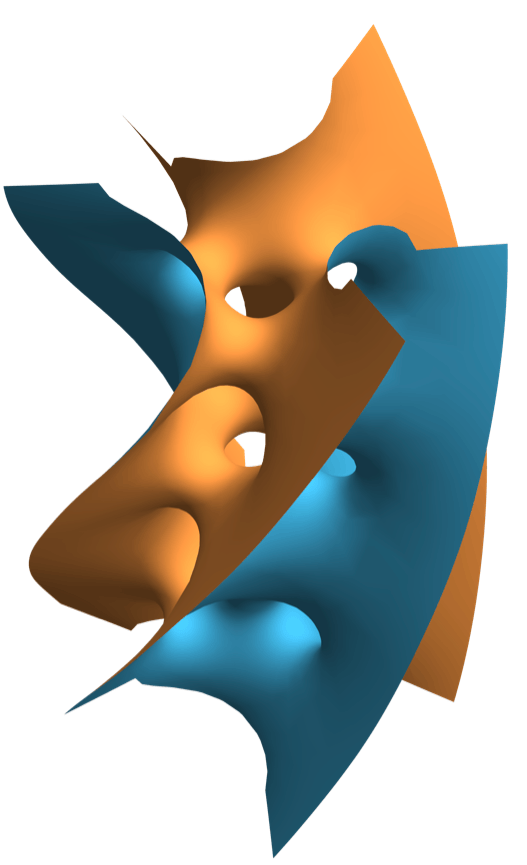
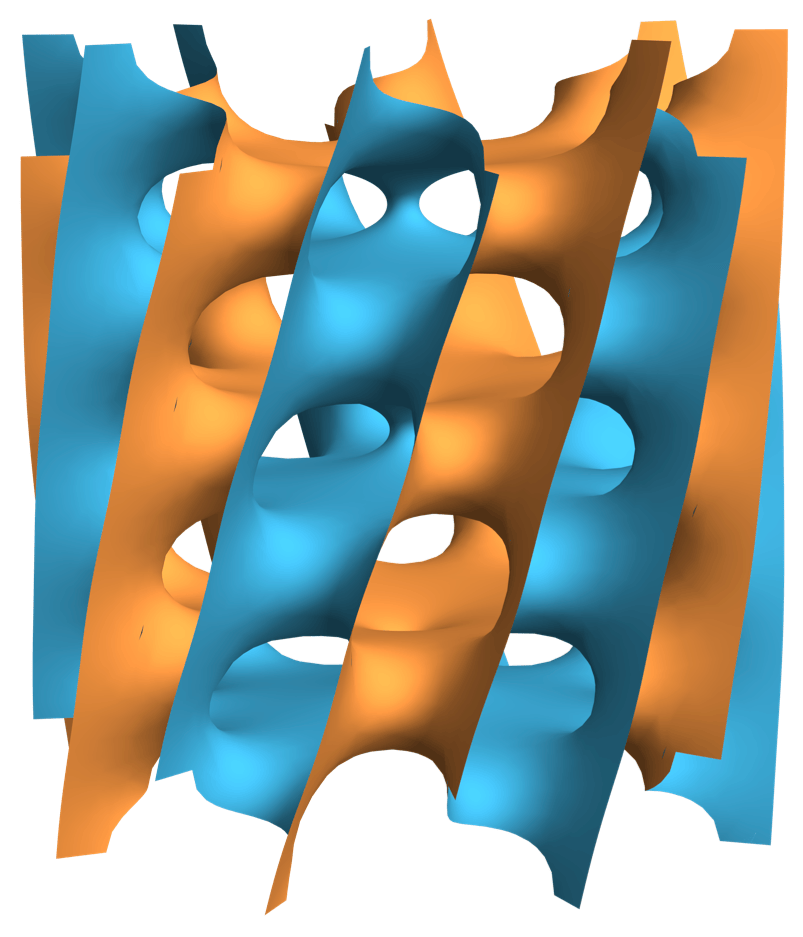
It’s time to explain what we have learned since.
Numerical experiments suggest that a toroidal Scherk surface with 2k ends can be deformed to a noded limit with one central catenoidal node and k helicoidal nodes, all of the same spin.
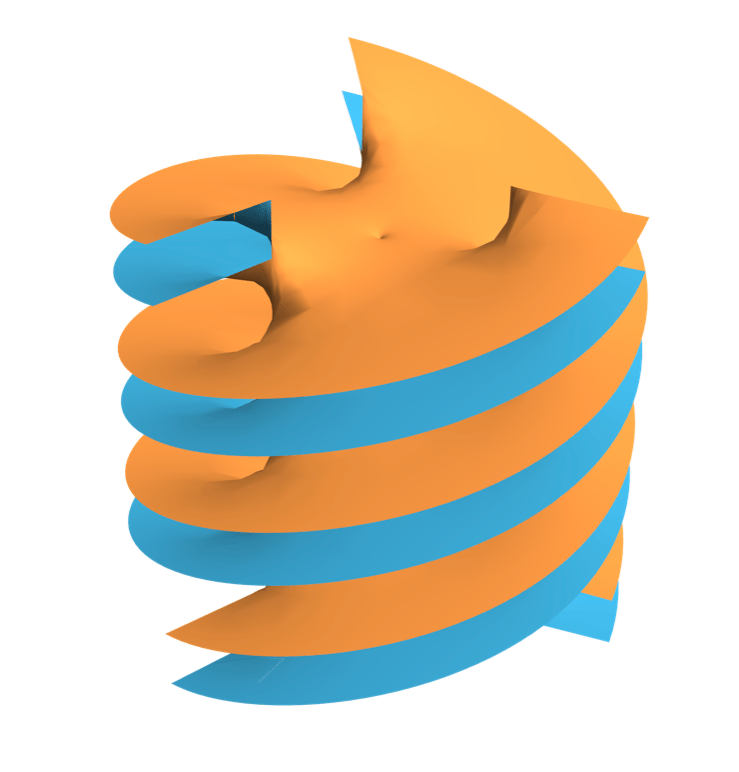
We have an AI-assisted proof that this noded limit admits an embedded regeneration.
We have partial results showing that this family will remain embedded until it reaches the toroidal Scherk surface, and then continue to twist again toward a symmetric limit.
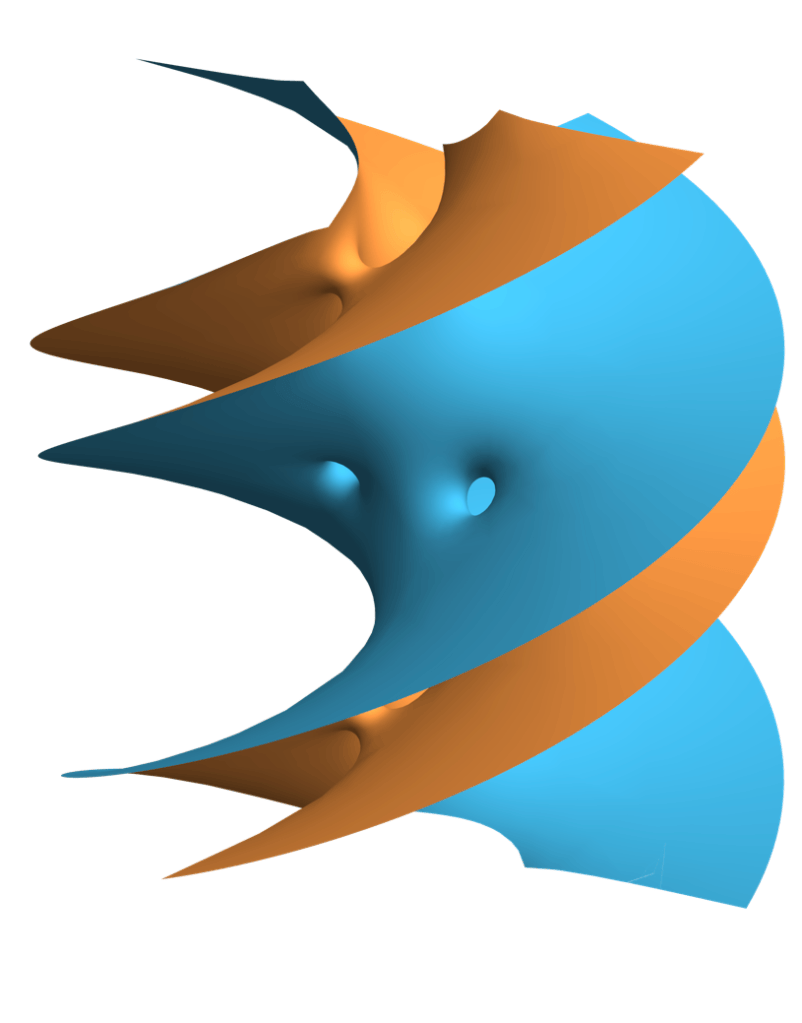
There was a surprise. This family also exists for k=2, starting at the noded limit using one catenoid and two helicoids. However, it does not reach the toroidal Scherk surface with four annular ends, which does not exist. It degenerates earlier to another noded limit double helicoid with two catenoidal necks in the quotient. We have an AI-assisted proof that this family exists as an embedded family for its entire range and degenerates as claimed. This is the first example of a completely new and unexpected noded surface construction. More examples will follow.
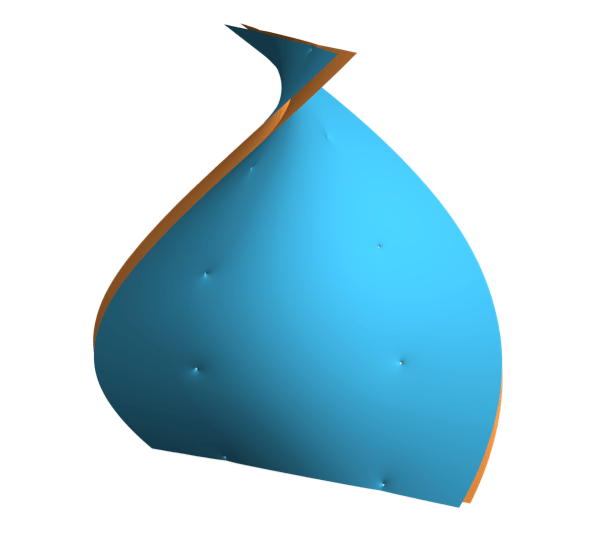
This is joint ongoing work with Carlos Cardona, Ramazan Yol, and Codex 6.1. We will make this research fully available in the next few days under a CC BY-NC-SA license.
We will be specific about which parts of this research are speculative, numerical, use interval arithmetic for certification, are AI-generated, are Lean-certified, or have been reviewed by humans. We invite collaborations. We believe that the advent of AI agents is not the end of mathematics, but the beginning of a new era of discovery like never before.


