The I-WP surface of Alan Schoen has a few things in common with yesterday’s chiral H’-T: Both surfaces admit an order 3 symmetry, and for I-WP, this suggests that one can deform the surface in the direction of the axis, just as it can be done with the rPD family. This has been investigated by Tom Yerger in his thesis. At one limiting end, we see a degeneration into an end-to-end gluing of Scherk surfaces similar (but not identical) to that of the chiral H’-T family:
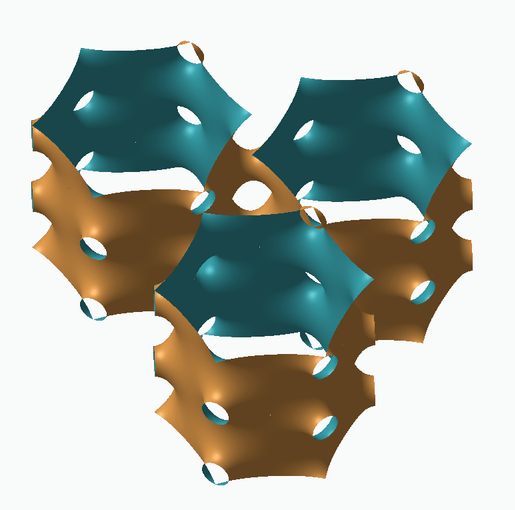
This is, however, where the similarities end. The I-WP family is centro-symmetric, and the quotient by the order 3 rotation has genus 2, not genus 1. All this makes the family much harder to describe. Following the diagonal symmetry path makes the surfaces more like the traditional I-WP surface.
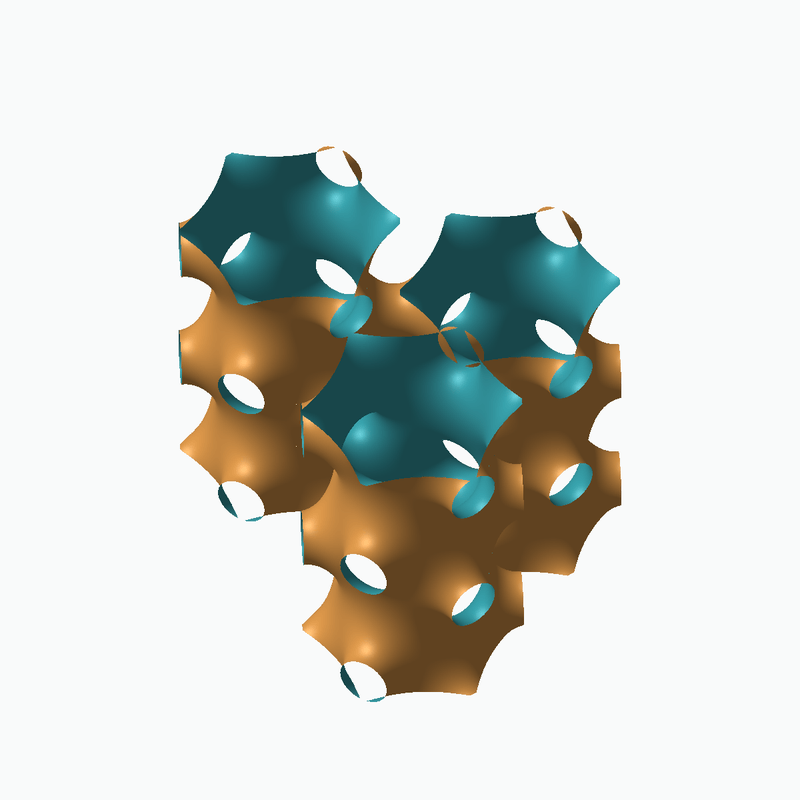
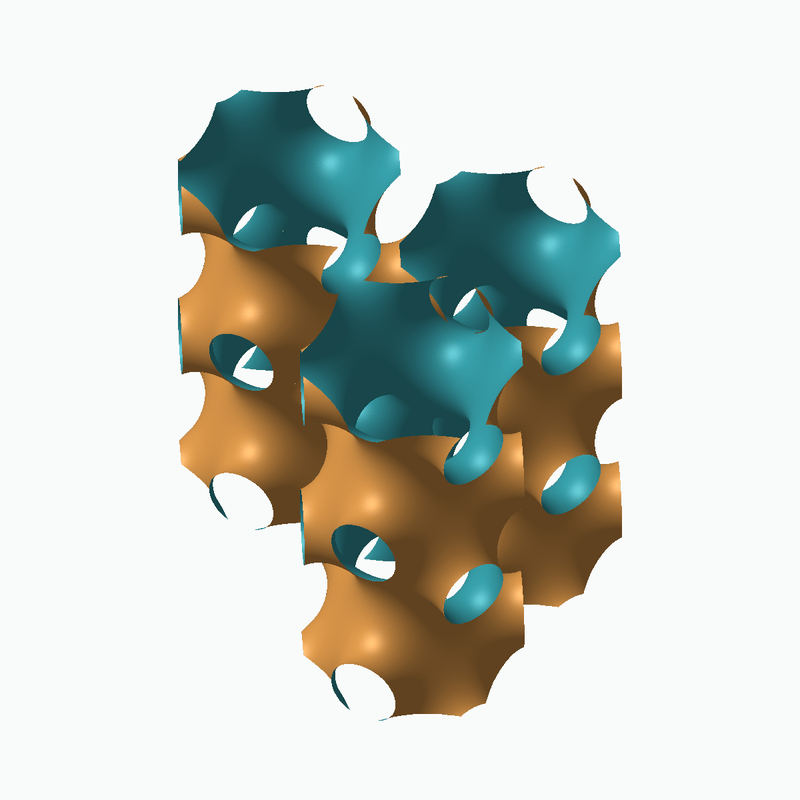
When we are slowly approaching the far end of this family
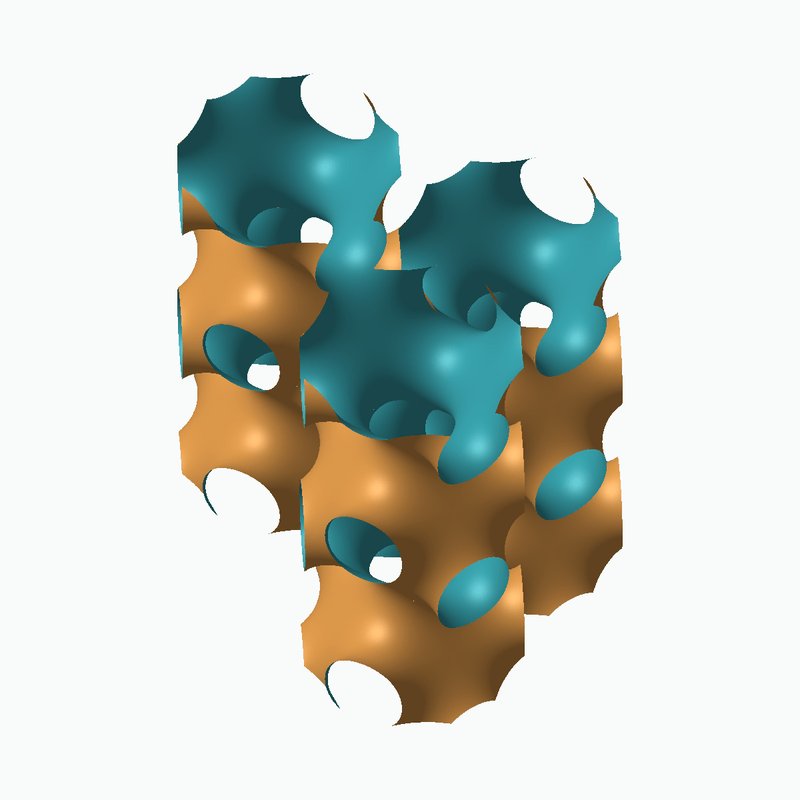
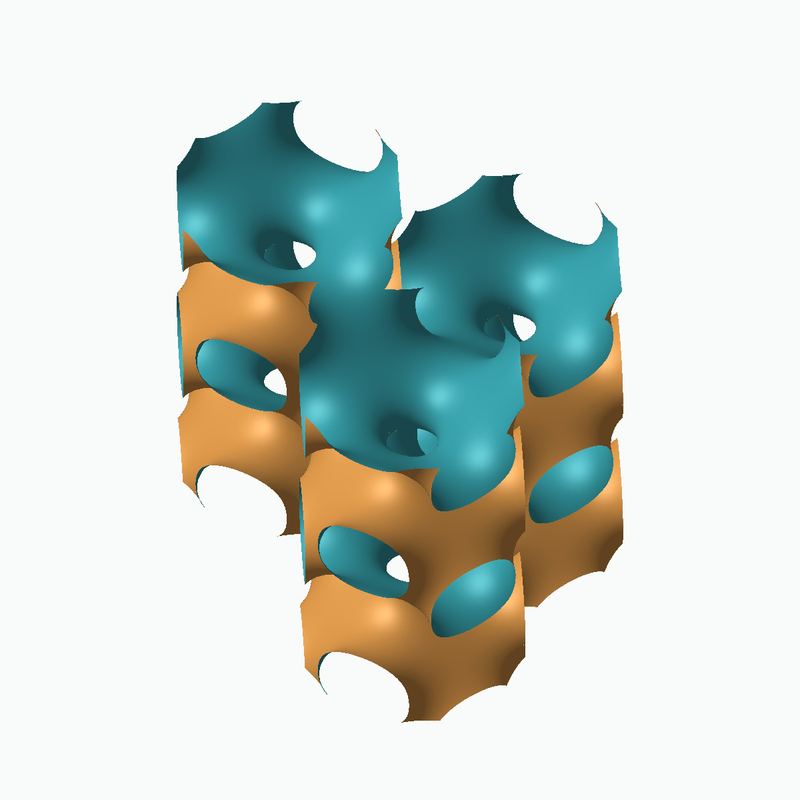
the surfaces approach a very different limit than the chiral H’-T:
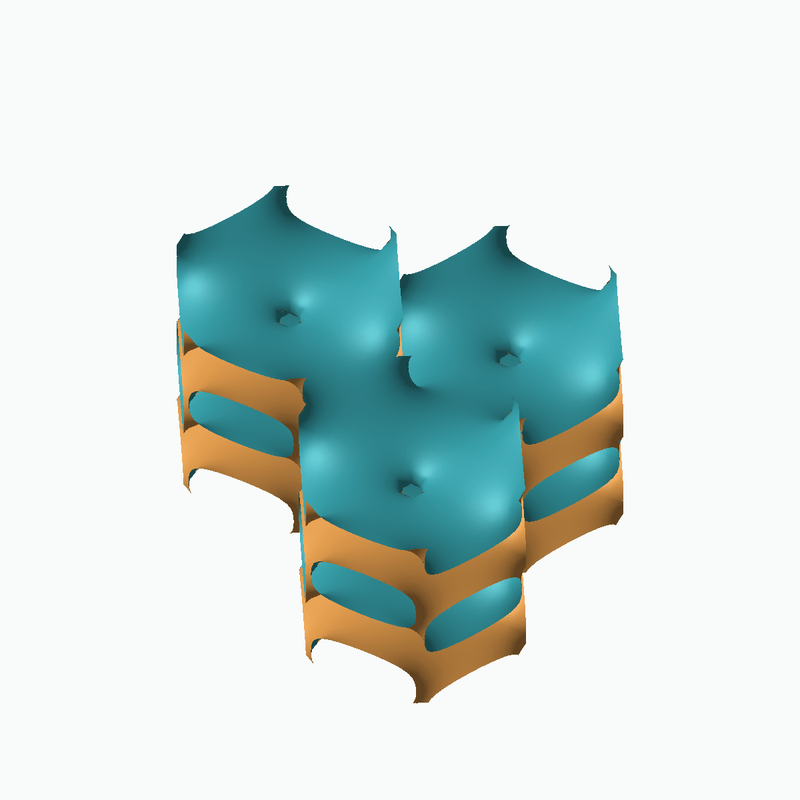
This is a nodal configuration with nodes at the centers and vertices of a tiling by regular hexagons, like so:
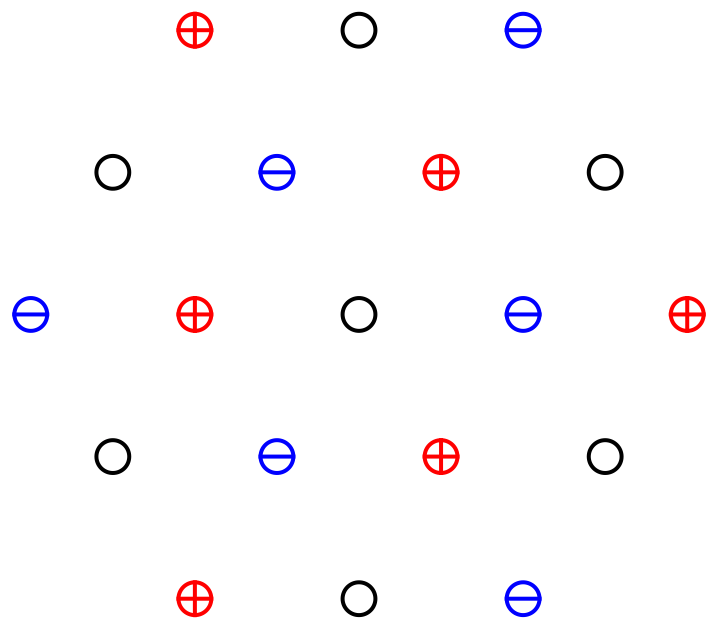
In a fundamental domain, this amounts to one catenoid and two helicoids (of opposite spin), so we can denote these surfaces by their nodal type as CH+H–. These “molecules” live in a different universe than the screw motion invariant surfaces earlier, the universe of triply periodic minimal surfaces where the laws of physics are different. The same nodal configuration without the catenoids is responsible for one limit of the rPD family.
Above is the family as an animation, and here is an existence and embeddedness proof that also identifies the limit surface, using interval arithmetic only for the embeddedness, generated by Kimi. This is also joint work with Tom and Carlos.


