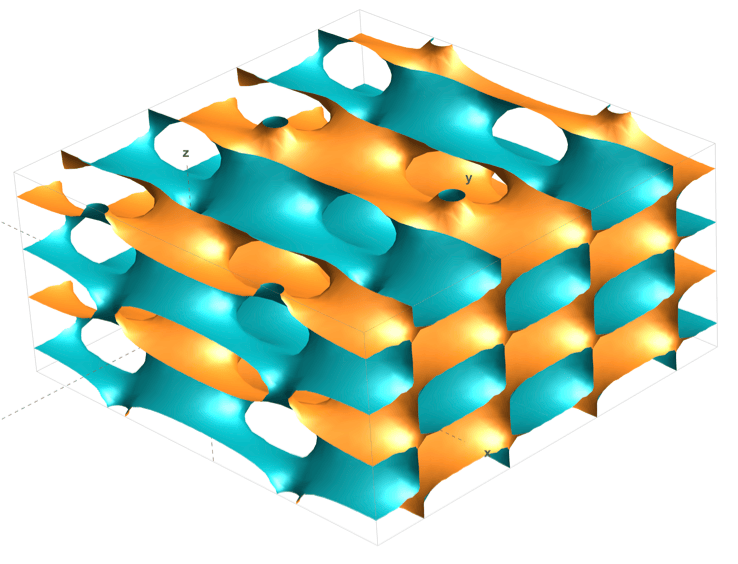
The space TPMS3 of embedded triply periodic minimal surfaces of genus 3 is complicated, but we have a lot of information (and known) examples: The surfaces are always hyperelliptic (the Gauss map has degree 3), there is an explicit 5-dimensional family (the Meeks family), the boundary is fairly well understood, and there is a second family that we hope to understand one day as well.
In contrast, surfaces in the space TPMS4 are never hyperelliptic, there is no explicit family, there are just a handful of examples, and our understanding of the boundary has gaps.
There is progress, however. Beginning with a mixed nodal limit consisting of two helicoidal and one helicoidal nodes, shown at the top. The animation above shows a slide deformation not unlike the one in the Two Towers post. Are they related?
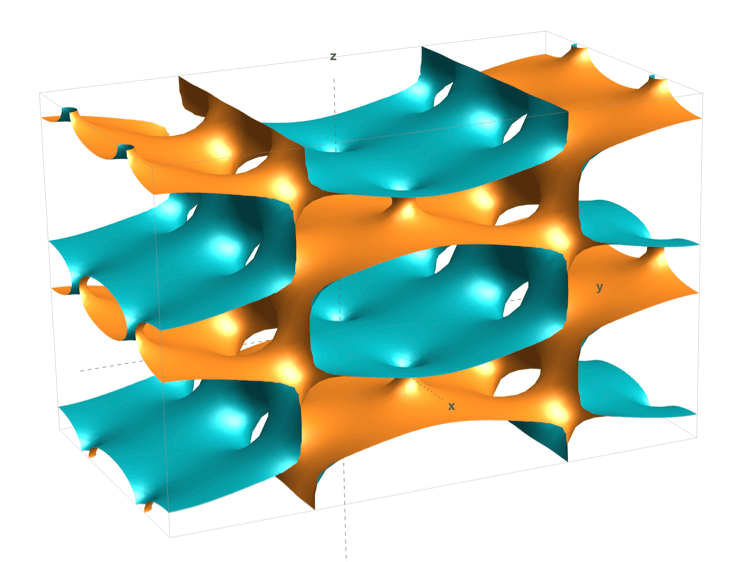
Attempt to understand these new surfaces uncovered some surprising results. There is a special component CS of TPMS4 consisting of centro-symmetric surfaces. All genus 4 surfaces found by Alan Schoen belong to CS. The non-degeneracy of I-WP implies that locally, CS is 5-dimensional. It directly generalizes the Meeks family in TPMS3. We have been able to connect all known examples in CS within CS. This is numerical evidence only so far, but suggests that CS is connected.
Then there are the new surfaces here, as well as recently found examples: The Triply periodic Costa surface, the CLP surface of genus 4 with lines, and the chiral H’-T surface proven to exist by Hao Chen, Shashank G. Markande, Matthias Saba, Gerd E. Schröder-Turk, and Elisabetta A. Matsumoto. None of these are in CS. So we call the closure of the complement of CS in TPMS4 the non-centro-symmetric locus (NCS). Above is a member of NCS which has all three coordinate axes as axes of rotational symmetry. It belongs to a 2-dimensional subfamily of NCS.
So far, we have been able to numerically connect all known examples in NCS within TPMS4, but not yet within NCS. So we conjecture that NCS is connected, but possibly not through surfaces in NCS alone.
CS and NCS intersect in a generically 4-dimensional family J of “junctions” or “bifurcations”; this locus is very little understood. Some junctions are visible in the Two Towers deformation, when it hits surfaces with additional reflectional symmetry that belong to the family of Wei surfaces (also in CS) or Alan Schoen’s deformed S’-S” surfaces.
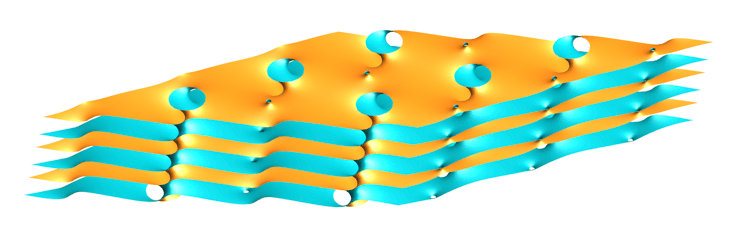
There are also surfaces of NCS near the nodal limits that consist of three catenoidal nodes.
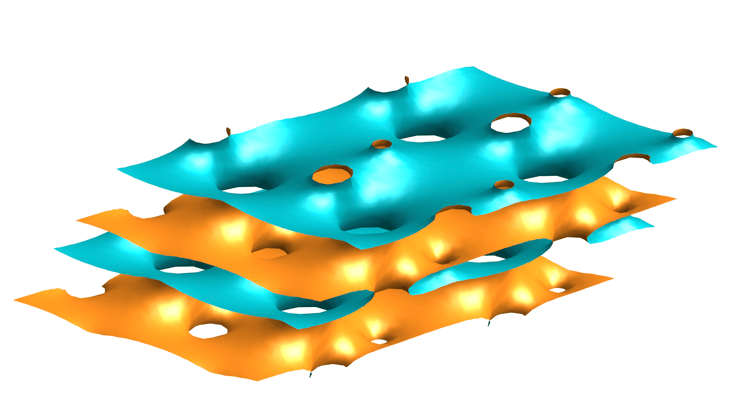
The one above has a half-turn symmetry; the one below has a reflectional symmetry plane.
There will be more soon …


