Martin Traizet pioneered the gluing of minimal surfaces using noded Riemann surfaces and catenoidal or helicoidal necks, which serve as elementary particles, forming molecules that have to satisfy balance equations. We will now start considering “molecules” consisting both of helicoids and catenoids. We have a local result that allows us to regenerate non-degenerate balanced configurations to embedded, screw motion invariant surfaces. Let’s illustrate this with an example:
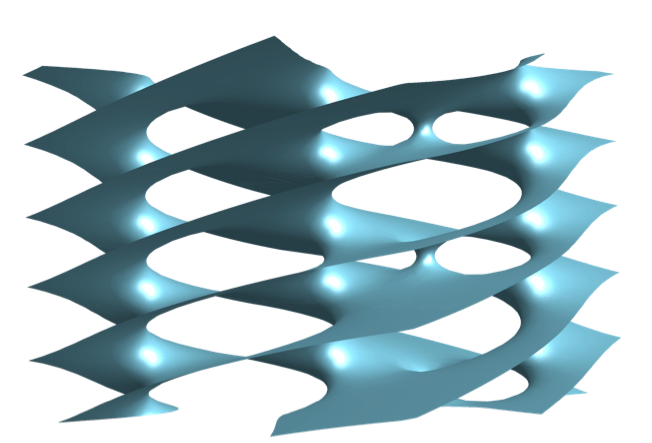
We start with three helicoids with the same spin placed at 0 and , the roots of the third Hermite polynomial, and a catenoidal neck at . The above image is already at about 6º twist, the one below at 28º.
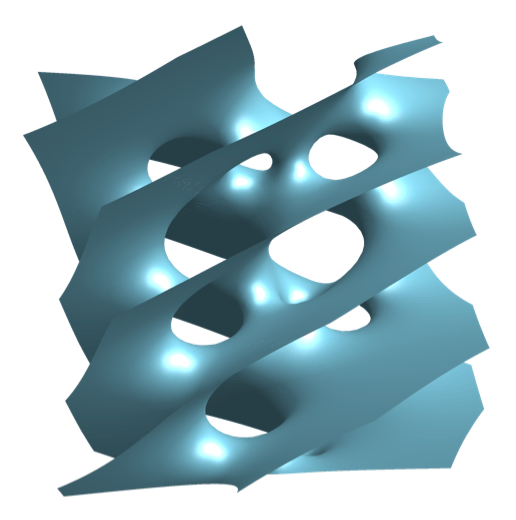
One central open question is: What will happen in the future? We only understand this in a few cases, and what you see here is purely numerical. When we keep twisting until we are getting close to 90º, a new degeneration pattern happens.
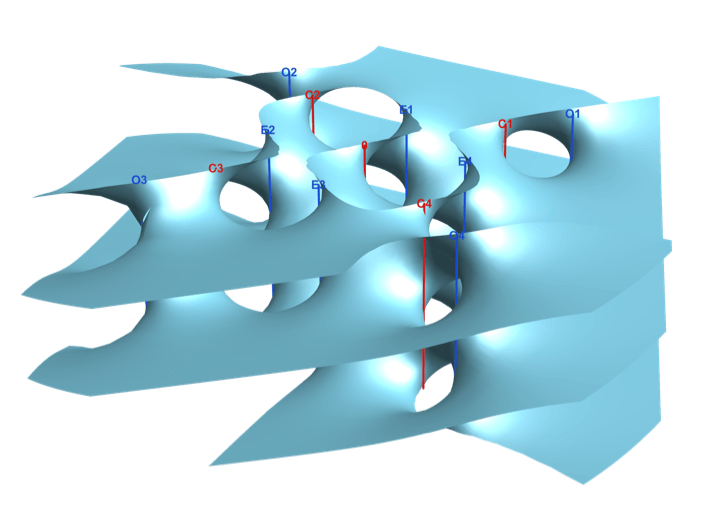
We reach a purely helicoidal balance configuration with 13 helicoids. This is covered by earlier work of Hao Chen and Daniel Freese. But where do all these helicoids come from? Let’s describe the remarkable balance configuration first: Let a>b>c>0 be the solutions of
Take the positions and spins to be
center: , spin = −1;
outer square: , spin = +1;
middle square: , spin = −1;
inner square: , spin = +1;
where .
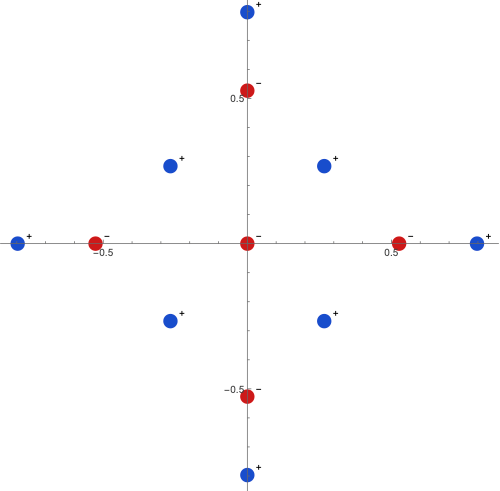
There are eight + and five − helicoids, with net spin 3. The central nine alone have net spin −1; adding the outer four gives . This is consistent with the end height winding of 3 of our original regenerated quotient surface . has genus and two ends. Passing to the fourfold cover multiplies its punctured Euler characteristic by four. Each end lifts to one end because . therefore has genus and two ends, matching the genus associated with helicoidal necks.
There will be more examples, theorems, and proofs.


