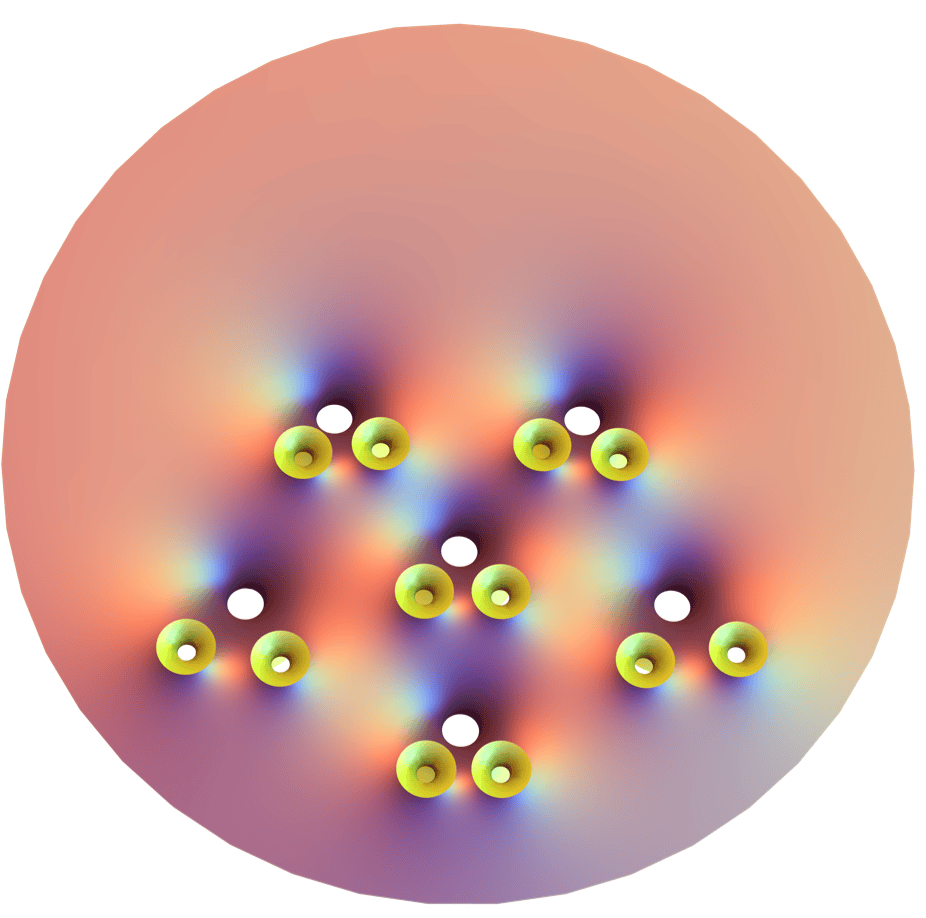
Today’s post is AI-free, we all need a break. As an exercise we tried to add catenoidal necks to the Finite Riemann surface. Our surfaces have genus 0, a slanted planar end and a finite number of vertical catenoids with (say) downward pointing normal.
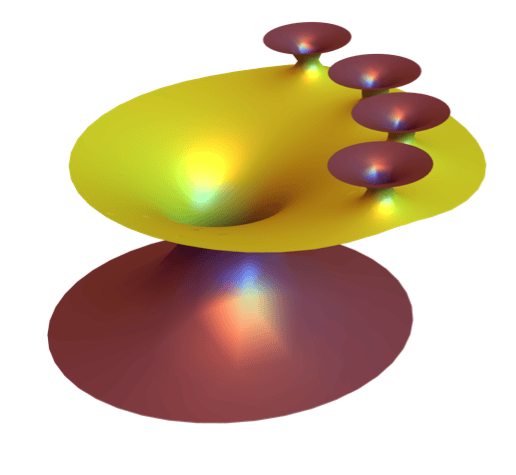
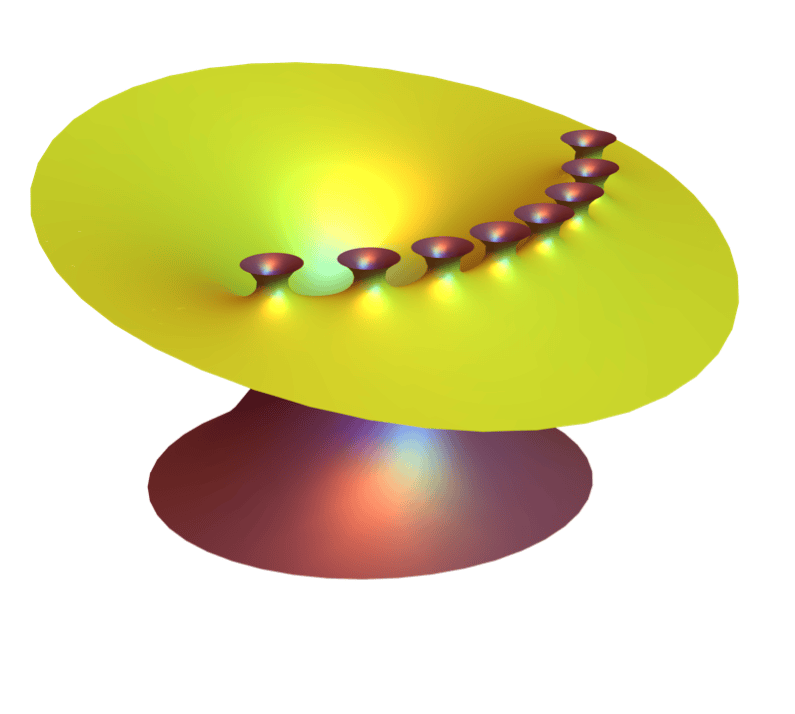
If the top n ends are supposed to have equal flux 1 and the bottom one balancing flux -n, there is, up to López-Ros deformation and similarity, only one such surface for each n. The punctures representing the upper catenoids are given by the zeroes of the reverse Bessel polynomials (using the normalization that the planar end is represented by infinity, and the bottom catenoidal end by 0.
More generally, and this is still elementary, if we want m top catenoidal ends with equal flux and n bottom catenoidal necks with equal balancing flux, then there are generally finitely many solutions. If we use polynomials P and Q to encode the locations of the m top and the n bottom catenoidal necks as before, then the period conditions are satisfied if and only if P and Q satisfy the Tkachenko equation
for . This equation is known as the translating vortex equation. In the special case that are equal triangle numbers, there is resonance, given by Adler-Moser polynomials and their companions. For instance, for , we have
Here, a is a complex parameter. Using it on the circle of radius 1/2 creates the following loop in moduli space:
Carlos and I are preparing a preprint documenting all this. In the meantime, a teaser about things to come: