One of the earliest discovered minimal surfaces is Scherk’s doubly periodic surface. It was for a long time the only doubly periodic example, until Karcher constructed a genus 1 version. His ideas could be generalized, providing examples in every genus.
It always struck me as curious that there were relatively few examples of doubly periodic minimal surfaces with non-parallel ends, so I was excited when I found an exotic genus 3 surface that is constructed using a different regime. Its existence was only established numerically, and the solution of the 3-dimensional period problem was not completely convincing
DeepSeek 4.1 has now provided a short existence proof using interval arithmetic. The embeddedness should also be possible to verify this way,
Moreover, DeepSeek found two more numerical exotic examples of genus 4 and 5, respectively, indexed (2,4) and (3,4):
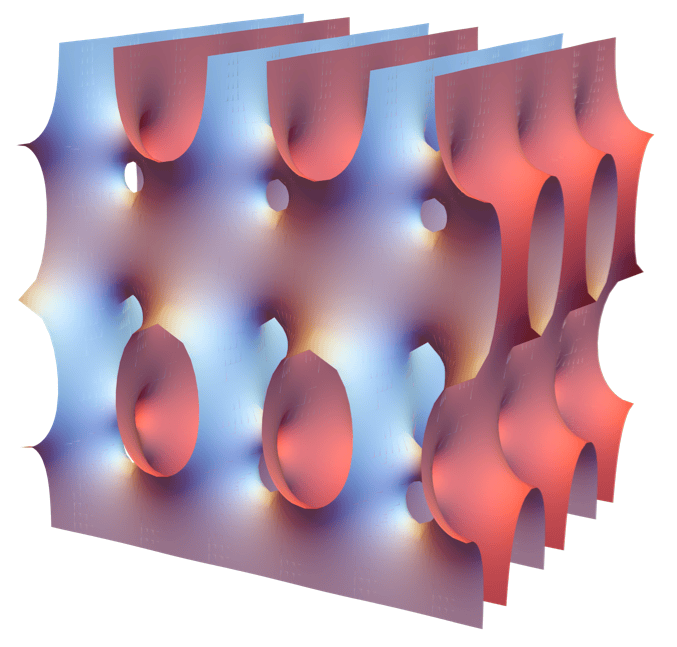
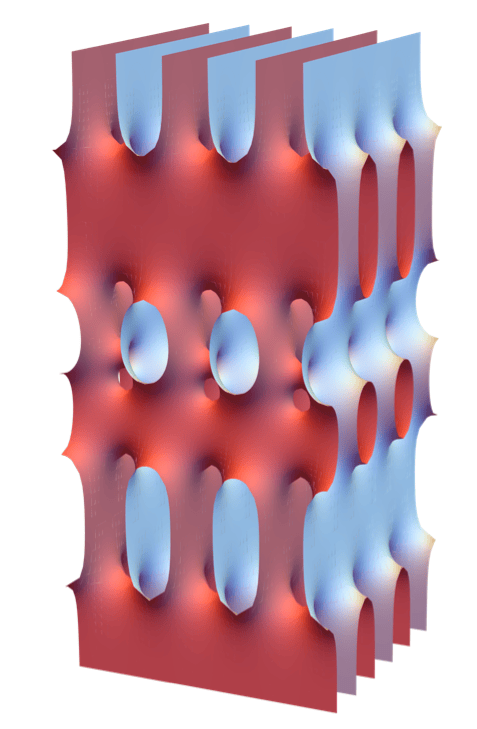
No attempts have been made to prove their existence so far. The (2,4) example poses a 4-dimensional period problem, and the parameters get dangerously small:
{a, b, c, d} = {0.000996073130645621226429845407365, 0.0177062891946157009857784281152, -0.00262129261382227938219672364734, 0.00522280110467842778603906877812};
The other surface requires an even more extreme parametrization. The (proven) Karcher-Scherk surfaces are indexed as (1,g), and I now believe there will be examples of type (m,n) for any pair (m,n) of positive integers with m<n. No numerical computation will prove a conjecture like this. Mathematics is infinite, after all.
I will soon post the existence proof for the (2,3) surface and the Mathematica notebooks for the other surfaces soon.


