Karcher’s Fence of Catenoids can be modified to become an alternating fence of half-catenoids:
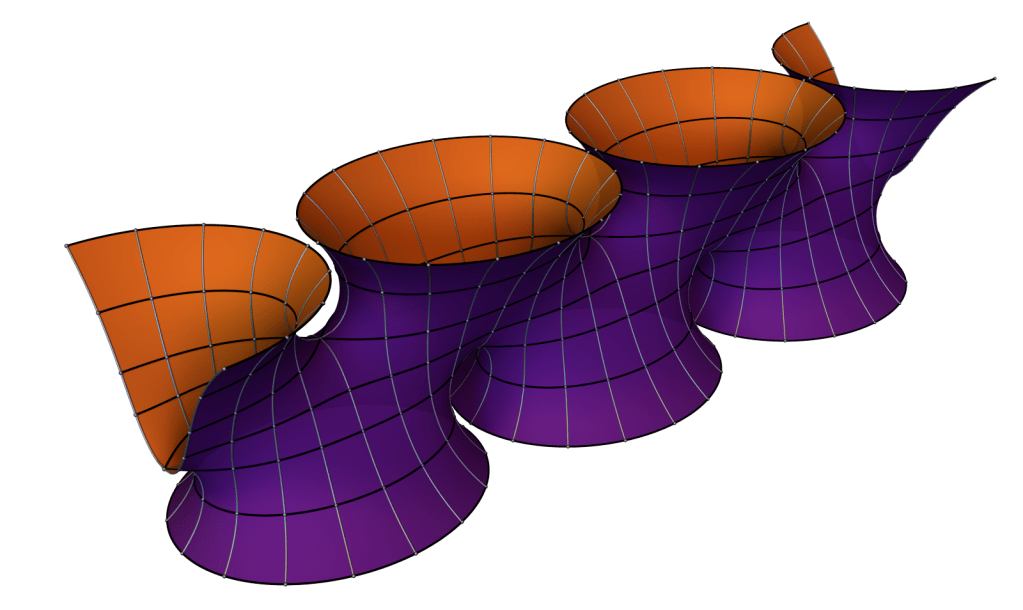
As a translation invariant surface, it has genus one and two catenoidal ends in the quotient and is symmetric with respect to a pair of vertical planes. As such, it comes in a 1-parameter family (with the rectangular quotient torus serving as the parameter).
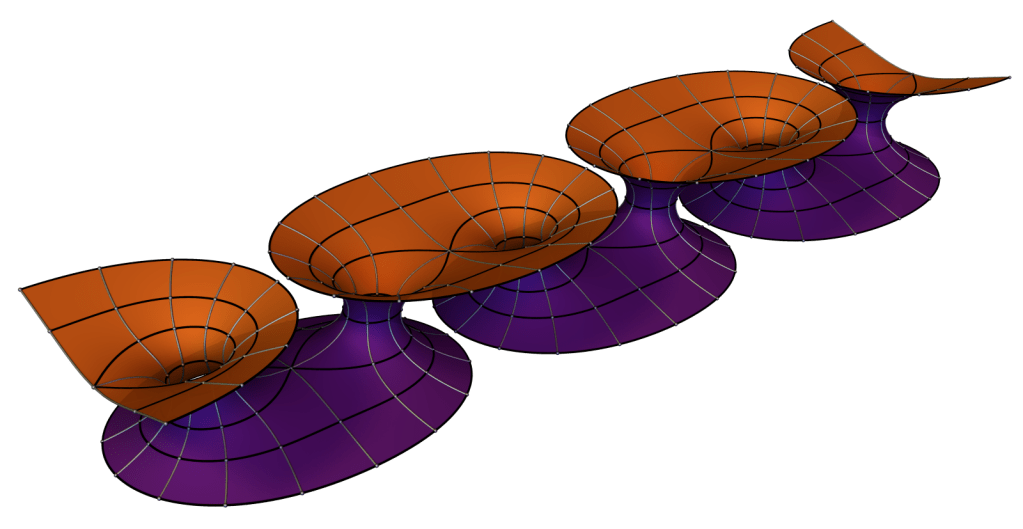
One can also consider this surface as screw-motion invariant, with 180º as the angle of rotation. This way the quotient becomes a toroidal 1-Noid.
While I am writing this, it occurs to me whether it is possible to replace each catenoidal end with a pair of Scherk ends, and obtain a new translation invariant embedded minimal surface. I don’t think so, but why does it have to fail?
 Minimal Surfaces